Genealogy & Chronology
Adam and Methuselah Were Alive at the Same Time
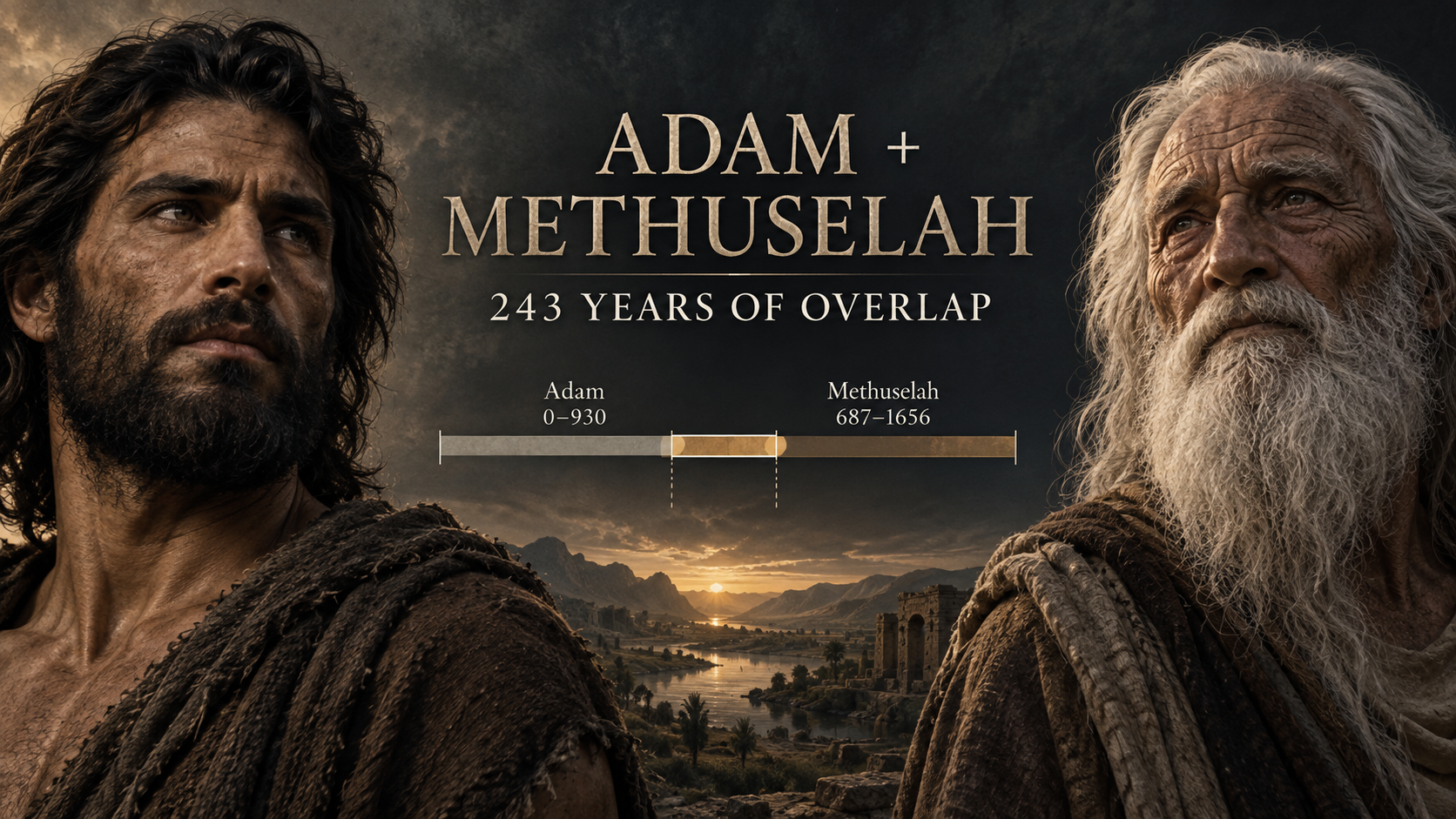
According to the ages recorded in Genesis 5, Methuselah was already 243 years old when Adam died. That surprising overlap connects Adam's generation much more closely to Noah's than we might imagine.
01
The investigation
Adam and Methuselah Were Alive at the Same Time
I was reading through the early chapters of Genesis when something caught my attention that I had never really thought about before.
Adam and Methuselah were alive at the same time.
Not just for a few years.
According to the ages recorded in Genesis 5, Methuselah was 243 years old when Adam died.
That was wild to me.
I had always thought of Adam, Methuselah, Noah, Abraham, and the other patriarchs as people who lived in completely separate periods of history. But once I started doing the math in Genesis, I realized the generations overlapped much more than I had imagined.
And that led to a lot more questions.
The Math Is Surprisingly Simple
Genesis tells us that Adam was 130 years old when Seth was born.
Seth was 105 when Enosh was born.
Enosh was 90 when Kenan was born.
Kenan was 70 when Mahalalel was born.
Mahalalel was 65 when Jared was born.
Jared was 162 when Enoch was born.
Enoch was 65 when Methuselah was born.
Add those ages together:
130 + 105 + 90 + 70 + 65 + 162 + 65 = 687
That means Methuselah was born when Adam was 687 years old.
Genesis 5:5 says Adam lived 930 years.
So:
930 - 687 = 243
Adam and Methuselah were alive at the same time for 243 years.
Scripture does not tell us they ever spoke to each other.
It does not tell us they met.
But it does tell us enough to know that their lives overlapped for more than two centuries.
And once you see that, the early Genesis timeline starts to feel very different.
Methuselah Was Noah’s Grandfather
This makes it even more interesting.
Methuselah was the father of Lamech.
Lamech was the father of Noah.
So Methuselah was Noah’s grandfather.
That means Methuselah lived during Adam’s lifetime and also during Noah’s lifetime.
He connects those generations in a way I had never really considered before.
Again, Scripture does not say Methuselah sat down with Adam and later repeated Adam’s stories to Noah.
We should not claim that happened.
But it is certainly possible that family members who lived together for centuries knew one another and passed down what they had seen, heard, and experienced.
That possibility is fascinating to think about.
Imagine the Questions Methuselah Could Have Asked Adam
If Methuselah did know Adam, I cannot imagine running out of questions.
What was Eden really like?
What did a perfect world feel like?
What was it like to walk with God before sin entered the world?
Genesis tells us God caused Adam to fall into a deep sleep, took one of his ribs, and formed Eve.
What did Adam remember about that?
What was it like to wake up and see Eve for the first time?
What was life like before death?
Before shame?
Before fear?
Before pain?
And then I would want to know about the fall.
What was it like when Adam and Eve realized they had sinned?
What was it like when they first felt shame?
What did Adam feel when God confronted him?
What was it like to leave Eden knowing he could never simply walk back in?
What Would Adam Have Said About Sin?
This is where I have to be careful.
Scripture does not record Adam giving advice to Methuselah.
So anything beyond the biblical record is imagination, not doctrine.
But think about Adam’s perspective.
Adam knew what the world was like before sin.
And Adam knew what the world became after sin.
He personally experienced both.
If anyone understood the consequences of disobedience, Adam did.
I cannot help wondering whether an older Adam might have warned his descendants about sin with a weight none of them could fully appreciate.
Something like:
Do not play with sin. I watched it change everything.
That is not a quotation from Scripture.
But it captures something that is undeniably true about Adam’s experience.
Adam lived with the consequences of that first act of disobedience for hundreds of years.
He watched pain enter the human story.
He saw death.
He experienced the murder of Abel.
He knew what had been lost.
Imagine the regret.
Imagine the wisdom that could have come from living with those consequences.
The Generations Were Closer Than They Seem
When we read Genesis quickly, centuries can disappear in a few verses.
A person dies.
Another person is born.
Another genealogy begins.
And it can make these people feel incredibly distant from one another.
But the actual chronology shows something different.
Their lives overlapped.
Adam lived long enough to see multiple generations of his descendants.
Methuselah lived long enough to overlap with Adam and then later with Noah.
That means the early biblical world was not necessarily a collection of isolated generations separated by forgotten centuries.
There were living connections between them.
Family history could have traveled through surprisingly few people.
What Scripture Says — and What It Doesn't
This distinction is important.
Scripture tells us:
Adam lived 930 years.
Methuselah descended from Adam through Seth.
Methuselah was born 687 years after Adam's creation according to the ages recorded in Genesis 5.
Therefore, their lives overlapped for 243 years.
Methuselah was the father of Lamech.
Lamech was the father of Noah.
So Methuselah was Noah's grandfather.
Scripture does not tell us:
Adam and Methuselah personally spoke.
Methuselah interviewed Adam about Eden.
Adam's memories were passed from Methuselah to Noah.
Those ideas are possibilities we can think about, but they should never be presented as things the Bible actually says.
And honestly, I think the facts are interesting enough without exaggerating them.
This One Question Changed How I Read Genesis
Finding this out made Genesis feel more connected to me.
Adam wasn't simply a name at the beginning of the Bible.
Methuselah wasn't simply “the guy who lived 969 years.”
Noah wasn't just the next major character.
They belonged to an overlapping family history.
And once I realized that, I kept digging.
Who else was alive at the same time?
How long did Noah overlap with other patriarchs?
Was Shem still alive when Abraham was alive?
How many generations actually separate the people we usually think of as living in completely different biblical eras?
One simple question opened up an entirely different way of looking at biblical chronology.
And that is exactly the kind of thing I want ASK. SEEK. ANSWER. to explore.
Ask the question.
Go back to Scripture.
Do the math.
Look at the history.
And see where the answer leads.