A Closer Look
Wet Sandals at the Jordan
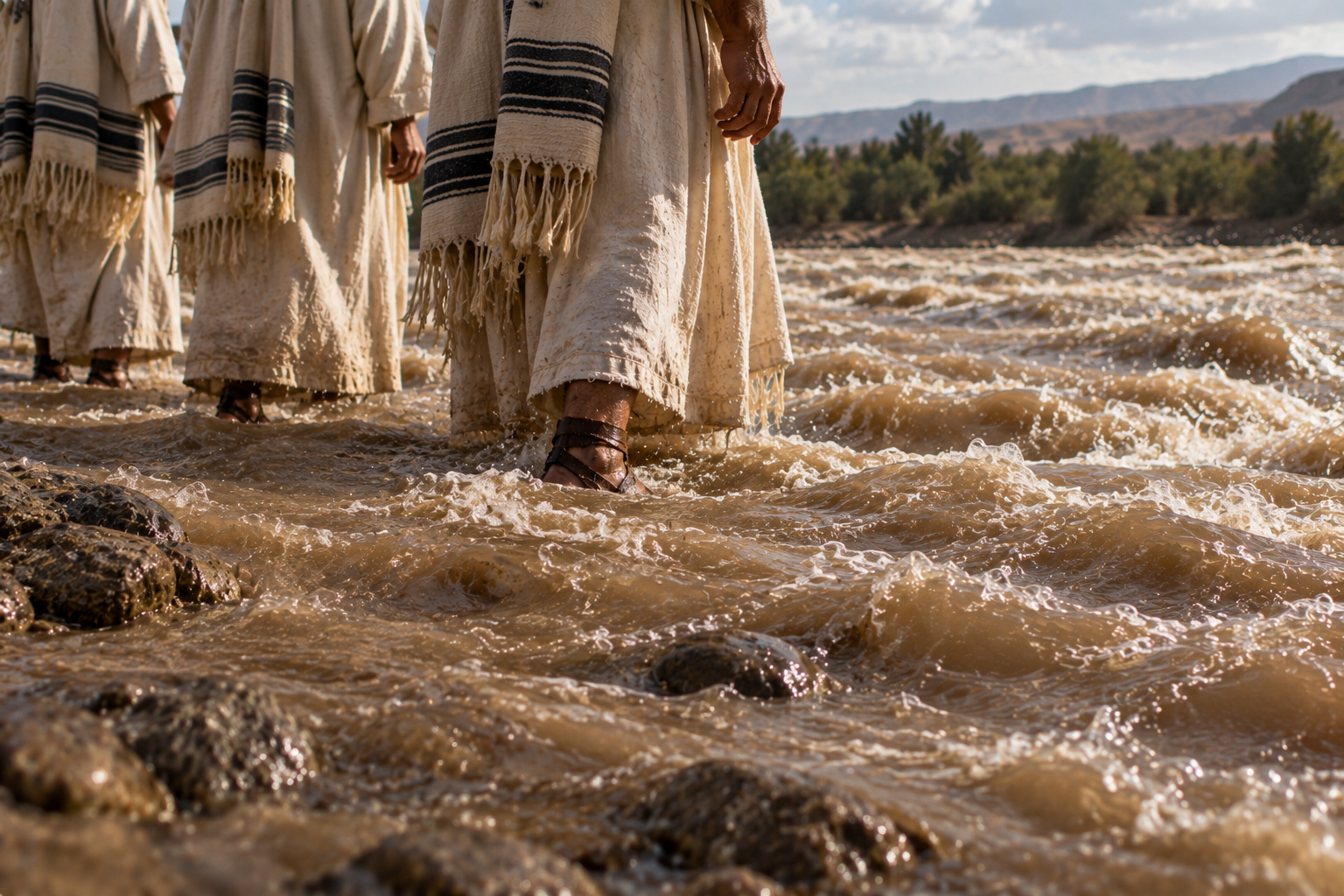
At the Edge of the Jordan
This morning, while reading Joshua 3–4, I tried to slow the account down in my mind.
Israel was finally preparing to cross into the land God had promised them.
Moses was gone. Joshua was now leading the people, following the instructions the Lord had given him.
And directly in front of them was the Jordan.
Joshua 3:15 tells us the river was overflowing its banks during the harvest season.
So before we picture dry ground, we have to picture the river first.
Moving water.
Overflowed banks.
The Jordan standing between Israel and the Promised Land ahead.
And then Joshua gave the command for the priests carrying the Ark of the Covenant to move forward.
What Was Joshua Seeing?
I wonder what that moment was like for Joshua.
He knew what the Lord had said would happen.
He had been told that when the priests carrying the Ark stepped into the Jordan, the waters would be cut off.
But knowing the Lord's promise and watching the priests actually walk toward the river are two different moments.
Joshua stood there responsible for leading Israel.
The people were watching him.
The priests were moving ahead.
And the Jordan was still flowing.
Scripture does not tell us what Joshua felt.
Was he calm?
Was he overwhelmed by the responsibility?
Was he watching the priests and waiting for the moment when the Lord would do exactly what He had promised?
We aren't told.
What we do know is that Joshua obeyed.
He gave the command.
And the priests moved.
The Priests Went First
The Ark went ahead of Israel.
The people were commanded to remain about 2,000 cubits away—roughly 3,000 feet, or a little over half a mile.
But Joshua 3:4 tells us why that distance mattered:
“that you may know the way by which you shall go, for you have not passed this way before.”
They had never traveled this way before.
They were entering unfamiliar ground, and the Ark was out in front showing them the way.
That changes the picture for me.
The priests were not simply walking ahead because they happened to be first in line.
They were carrying the Ark of the Covenant before the people, and Israel was watching from a distance as they followed the way the Lord was leading them.
Try to picture that distance.
More than half a mile separated the Ark from the people.
Behind the priests were the tribes of Israel—families, parents, children, livestock.
Ahead of them was the overflowing Jordan.
And they kept walking.
This is the part of the account that holds my attention.
What were those men thinking as they drew closer?
Could they hear the river growing louder?
Could they smell the wet earth and vegetation along its banks?
Could they feel the warmth of the sun as they approached?
Those details are not recorded, so we cannot say.
But these were real men approaching a real river, carrying the Ark according to the Lord's command.
Behind them was a nation that had never gone this way before.
And they were the ones being led forward first.
Then Their Feet Entered the Water
Joshua 3:15 tells us exactly when the moment came.
The priests reached the Jordan, and their feet dipped into the edge of the water.
Then the waters coming downstream were cut off.
I keep coming back to that order.
They reached the water first.
Then God acted.
What must it have been like to experience that from only a few feet away?
One moment, the Jordan was flowing in front of them.
Then the water coming from upstream was no longer continuing past them.
Joshua says it rose up in a heap far away at Adam, beside Zarethan, while the water flowing toward the Salt Sea was cut off.
What did that transition sound like?
Was there a sudden change in the roar of the current?
Did the sound of moving water fade around them?
What did they see as the flow disappeared downstream?
Did fish move with the retreating water? Did small pools remain for a moment in low places?
Scripture doesn't tell us those details, so they remain questions.
But the priests were standing there while the physical world around them changed because God had done exactly what He said He would do.
That is difficult for me to read quickly.
What Would It Be Like to Witness That?
Were they afraid?
Humbled?
Amazed?
Filled with worship?
Did one priest look at another in disbelief?
Did anyone say anything at all?
We don't know.
And I don't want to give them emotions or words Scripture never gives them.
But whatever they felt, they were firsthand witnesses to the power of God.
They did not hear about this years later.
They were there.
They approached the river while it was flowing.
Their feet entered the water.
And then they stood where a river had just been.
That had to change the way they understood the God they were following.
Not confidence in themselves.
Not confidence in Joshua's ability to engineer a crossing.
Confidence that the Lord who had commanded them forward was truly the God who could make a way through the Jordan.
What Did Israel See From Behind?
Now think about the people waiting behind them.
More than half a mile separated Israel from the Ark.
Maybe somewhere in that crowd was a mother holding a child's hand.
Maybe a child was trying to see around the adults in front of him.
Maybe families were watching the priests disappear farther ahead toward the river.
Again, Scripture does not give us those individuals.
But there were real families among Israel.
Real parents.
Real children.
And they were watching something unfold in front of them that none of them had ever experienced before.
The priests reached the Jordan.
The river was cut off.
Then Israel began to move.
What would it have been like for a child to walk down toward the river after watching the Ark go first?
What would a mother have thought as she stepped onto ground that had been beneath the Jordan only a short time before?
That is the kind of moment I want to slow down enough to see.
Standing in the Middle of the Jordan
Joshua 3:17 says the priests carrying the Ark stood firmly on dry ground in the middle of the Jordan while all Israel crossed.
That may be the most striking image in the whole account.
They stayed there.
The nation passed through.
And those priests stood in the middle of what had been a flowing river.
What did the exposed riverbed look like?
What did the ground beneath them feel like?
Scripture calls it dry ground, so whatever God did, Israel was able to cross.
Did the air still carry the smell of the river?
Could they hear the voices and movement of Israel passing around them?
What did it feel like to look toward one bank and then the other and realize where they were standing?
We don't know.
But they remained there until everything the Lord had commanded was completed.
Twelve Stones From That Exact Place
Then twelve men, one from each tribe, came into the riverbed.
Joshua told them to take twelve stones from the place where the priests' feet stood firm.
Each man carried a stone out on his shoulder.
Those stones would become a memorial.
Later, children would ask:
“What do these stones mean?”
And Israel would tell them what happened at the Jordan.
I love that.
God did not want this moment forgotten.
The stones gave future generations something they could see, touch, and ask about.
And the answer always led back to what the Lord had done.
Then the River Came Back
After Israel had crossed and everything was finished, the priests were commanded to come up out of the Jordan.
Joshua 4:18 says that when their feet reached dry ground, the waters returned to their place and overflowed the banks as before.
Imagine being one of those priests.
You walked toward an overflowing river.
You stepped into its edge.
You watched the waters stop.
You stood in the middle while a nation crossed.
Then you walked out.
And the river returned behind you.
Again, Scripture does not tell us what those men said afterward.
Maybe that silence is part of what makes the account so powerful.
We are simply told what God did.
What Stayed With Me
I think that is why this passage stayed with me this morning.
It is easy to read:
Israel crossed the Jordan.
And move on.
But there were people standing there when it happened.
Joshua was leading.
Israel was watching.
And the priests were the first ones walking toward the water.
I wonder what they remembered years later.
The sound of the river?
The moment their feet entered the water?
Standing in the middle while Israel passed by?
Watching the Jordan return after they came out?
We don't know.
But they had experienced something firsthand that they could never credit to themselves.
They obeyed.
God acted.
And they witnessed His power from the middle of the Jordan.
That is what I see now when I read Joshua 3–4.
And that is what I think about when I hear the words:
Wet Sandals at the Jordan.
Historical context
Israel's setting
The crossing takes place after the death of Moses as Joshua begins leading Israel into the land west of the Jordan.
Israel had come through decades in the wilderness and was now positioned east of the Jordan opposite Jericho.
The Jordan during harvest
Joshua 3:15 specifically says that the Jordan overflowed its banks throughout the harvest season.
That is an important part of the biblical description.
The distance from the Ark
Israel was commanded to remain approximately:
2,000 cubits — roughly 3,000 feet, or a little over half a mile from the Ark.
The modern conversion is approximate because the length of a cubit could vary.
Transporting the Ark
The Ark was designed with rings and poles for transportation.
It was to be carried according to God's prescribed instructions, and the holy object itself was not to be touched directly.
Archaeology & evidence
Geography of the account
Joshua identifies several geographical locations and features:
Jordan River
Jericho
the Arabah
the Salt Sea, commonly called the Dead Sea today
Adam
Zarethan
The Jordan River, Jericho region, Arabah, and Dead Sea are recognizable geographical locations.
Scripture references
Primary account
Joshua 3:1–17
Israel prepares to cross the Jordan. The priests carrying the Ark go ahead of the people. Their feet enter the edge of the water, the Jordan is cut off, and they stand on dry ground while Israel crosses.
Joshua 4:1–24
Twelve stones are taken from the Jordan. The priests remain in the river until the crossing is completed. They then come out, and the waters return.
Supporting passages
Exodus 25:10–15
Instructions for constructing the Ark, including its rings and carrying poles.
Numbers 4:15
Those responsible for carrying the holy things were not to touch them directly.
Numbers 7:9
The Kohathites carried the holy things assigned to them on the shoulder.
1 Chronicles 15:15
The Levites are later specifically described carrying the Ark with its poles according to the command given through Moses.
Continue the inquiry

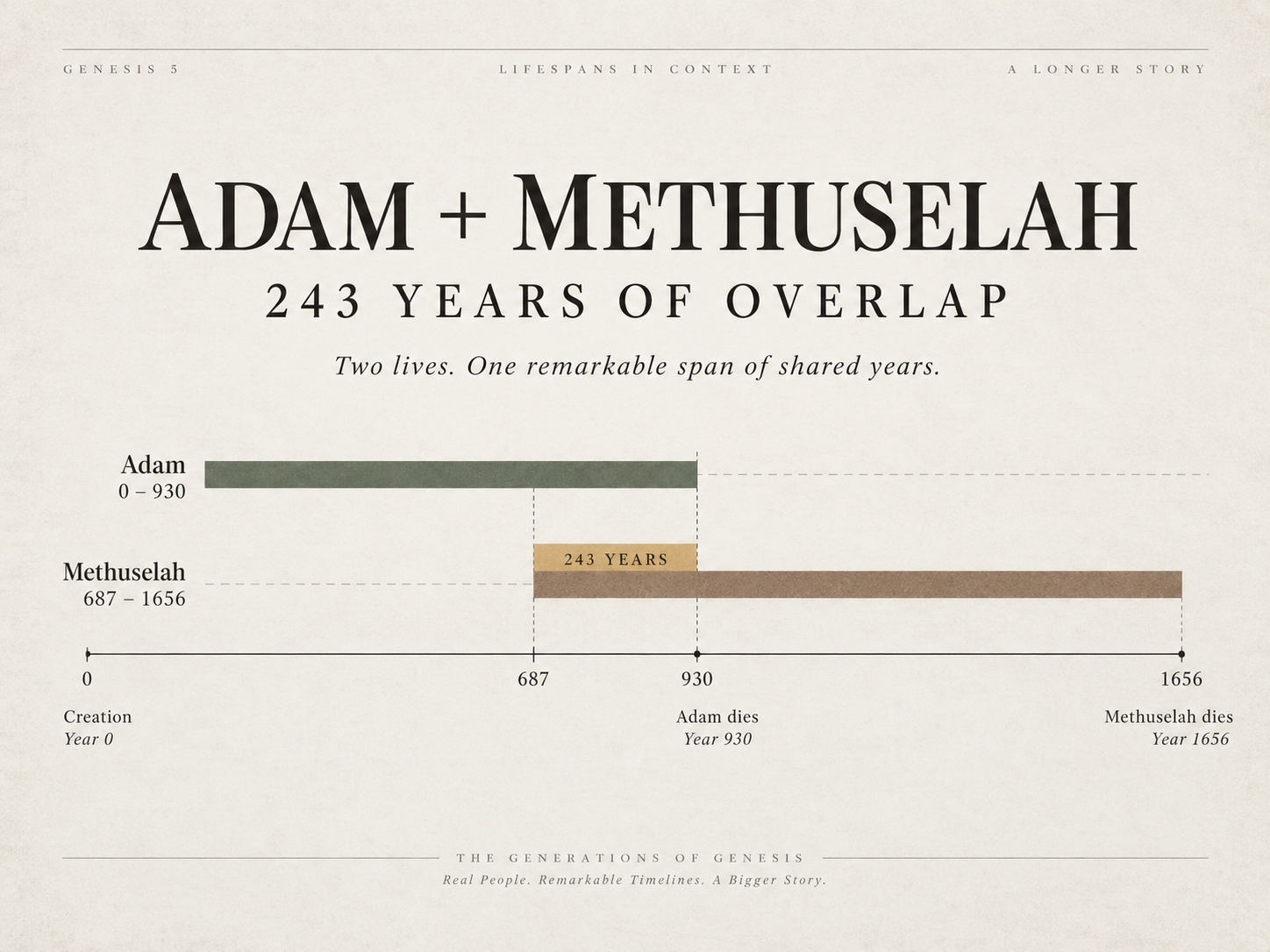
Adam and Methuselah Were Alive at the Same Time
According to the ages recorded in Genesis 5, Methuselah was already 243 years old when Adam died. That surprising overlap connects Adam's generation much more closely to Noah's than we might imagine.
Read the answer